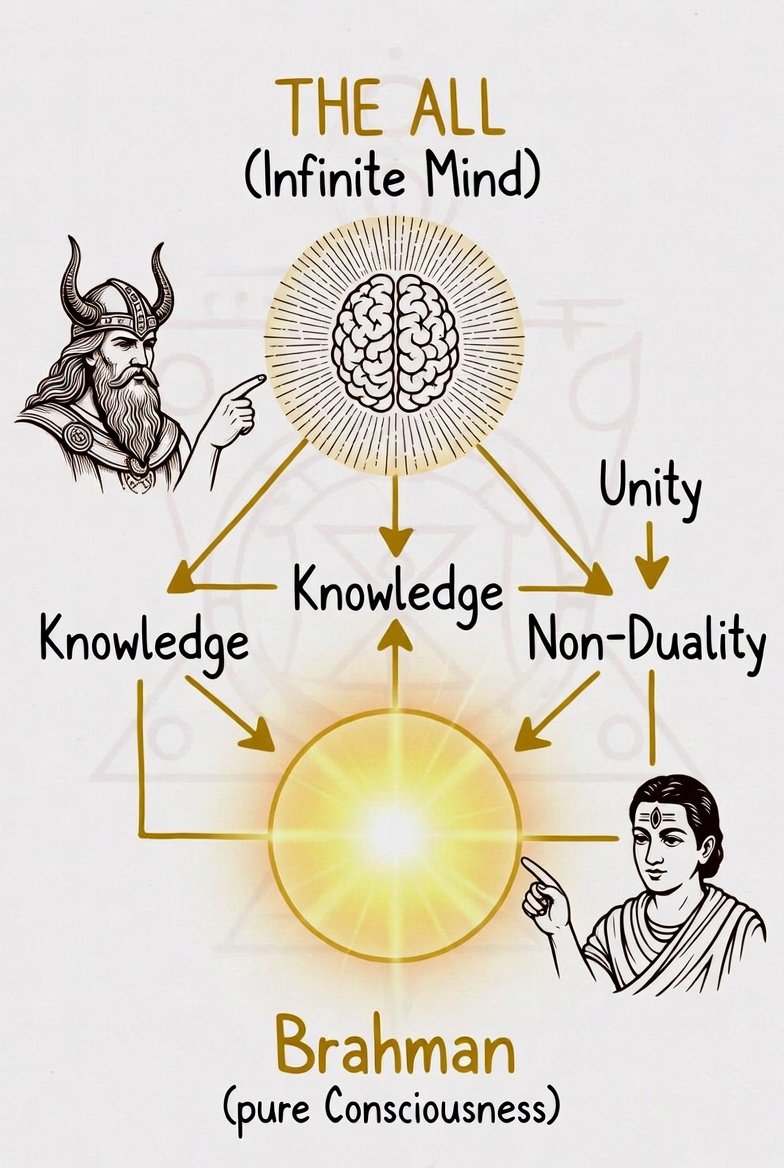
The All is Mind the Universe is Mental. The universe is mental, so the acquisition of knowledge and the building of consciousness is the highest priority above all things in the Odinic Mysteries. Without an understanding of this first and basic principle, all further knowledge is moot. - Esoterica
From a modern esoteric interpretation of Odinic Mysteries (also called Odinism in some contexts), a contemporary revival and mystical reconstruction of Norse/Germanic pagan spirituality centered on Odin (the All-Father, god of wisdom, poetry, runes, magic, self-sacrifice, and seeking knowledge at any cost). It appears in writings associated with certain Odinist groups or thinkers, most directly traceable to a 2018 blog post titled "The Quick n Dirty Philosophy of the Odinic Mysteries" (on esoterica812153291.wordpress.com), where the exact phrasing is used as the first core point of their philosophical framework. Similar ideas circulate in fringe or syncretic Odinist/Asatru literature that blends ancient Norse lore with 19th-20th century occult Hermeticism.
The passage fuses two main streams:
- The first Hermetic principle from The Kybalion (1908, anonymous but attributed to "Three Initiates," a key text in modern Western esotericism/New Thought): "THE ALL IS MIND; The Universe is Mental."
- A re-interpretation through an Odinic lens, where Odin's relentless pursuit of wisdom (hanging on Yggdrasil for the runes, sacrificing his eye at Mímir's well, etc.) is elevated as the archetypal model for human spiritual priority.
Breaking it down step by step
- The All is Mind the Universe is Mental This is a direct lift from the Principle of Mentalism in The Kybalion:
- "THE ALL" = the ultimate, infinite, unknowable source/reality (what Hermeticism calls the Divine Mind, the Absolute, or Godhead — not a personal deity but the totality of existence).
- Everything that exists (the Universe) is a mental creation/projection of THE ALL. Matter, energy, time, space, gods, humans — all are thoughts/ideas within this Infinite Mind.
- The universe isn't "solid" or primarily material; it's mental in nature — like a dream in the mind of the dreamer, or a hologram projected from consciousness.
- This echoes idealist philosophies (e.g., Plato's realm of Forms, Advaita Vedanta's Brahman, or even aspects of quantum observer effects in popular interpretations), but in Hermetic form it's practical: if reality is mental, then changing your mind changes reality (via focused will, visualization, etc.).
- The universe is mental, so the acquisition of knowledge and the building of consciousness is the highest priority above all things in the Odinic Mysteries Here the text applies the Hermetic principle specifically to Odinic spirituality:
- Odin embodies the supreme value of knowledge-seeking (gnosis/wisdom) above comfort, safety, power, or even life itself — he gives an eye for insight, hangs himself for rune-knowledge, wanders endlessly in quest of understanding.
- If the universe is fundamentally mental (a product of Mind), then the most direct way to align with, understand, master, or participate in reality is to expand and refine your own consciousness.
- "Building of consciousness" = developing awareness, insight, self-knowledge, rune-wisdom, magical perception, and higher states of mind — not mere intellectual facts, but transformative gnosis that awakens the divine spark within.
- In this view, other pursuits (wealth, battle-glory, family, even worship of other gods) are secondary or supportive; true Odinic initiation prioritizes the mind's evolution because that's how one communes with THE ALL / the deeper cosmic Mind (which some Odinists equate symbolically with Odin's overarching wisdom).
- Without an understanding of this first and basic principle, all further knowledge is moot This is the Hermetic warning restated: Mentalism is the foundational axiom.
- If you ignore that everything is mental, then any "knowledge" you gain (runes, myths, rituals, ethics) remains superficial or illusory — operating only on the level of appearance (the "phenomenal world") rather than essence.
- It's like building a house on sand: without grasping the mental nature of reality, further study/practice lacks ultimate grounding and transformative power.
- In Odinic terms: you can memorize Eddas, perform blots, fight bravely — but without this realization, you're missing the point of Odin's sacrifices (which were for wisdom/insight, not just power or survival).
Overall significance in this framework
This teaching represents a syncretic, esoteric Odinism — not strict historical reconstruction of pre-Christian Norse religion (which had no direct equivalent to Hermetic Mentalism), but a modern mystical philosophy that grafts The Kybalion's principles onto Odin's archetype to create a path of gnostic self-mastery and consciousness-expansion.
- It elevates Odin as the model initiate: the god who understands reality's mental essence and pursues infinite knowledge accordingly.
- The priority on "building consciousness" aligns with Odin's shamanic/ecstatic side (seidr, rune-magic, visionary quests) over purely martial or fertility aspects (Thor/Freyr).
- In groups influenced by this (some branches of the Odinic Rite, folkish Odinist writings, or independent mystics), it serves as a metaphysical foundation for practices like rune-meditation, dream-work, active imagination, and seeking "higher" wisdom through sacrifice/discipline.
- It can appeal to those drawn to both Norse pagan revival and Western occult/Hermetic traditions, framing Odinism as a "Northern Hermeticism" where mind/consciousness is the key to unlocking the runes, the self, and the cosmos.
In short: If the universe is a mental creation of THE ALL, then — following Odin's example — the ultimate spiritual imperative is to awaken, expand, and refine your own mind/consciousness. All else flows from (or is secondary to) that realization. This makes knowledge-seeking not just valuable, but the supreme Odinic virtue.
Compared to Advaita Vedanta
The quote from the Odinic Mysteries—"The All is Mind the Universe is Mental"—is a direct statement of the Principle of Mentalism from The Kybalion (1908), a modern Hermetic text. It posits that ultimate reality ("THE ALL") is Infinite Mind/Consciousness, and the entire universe is a mental projection or manifestation within that Mind. In the Odinic context, this elevates knowledge-seeking and consciousness-expansion as the supreme priority, mirroring Odin's mythic pursuit of wisdom.
Advaita Vedanta (non-dual Vedanta, primarily expounded by Adi Shankara in the 8th century CE, rooted in the Upanishads, Brahma Sutras, and Bhagavad Gita) shares striking surface similarities but also key differences in metaphysics, ontology, soteriology (path to liberation), and emphasis. Below is a structured comparison.
Core Similarities
- Reality is fundamentally Consciousness/Mind
- In the Kybalion/Hermetic Mentalism (and thus the Odinic adaptation): THE ALL is pure Mind; the universe is mental in essence — everything arises as thought/idea within this Infinite Consciousness.
- In Advaita Vedanta: Brahman is the sole Reality — pure, non-dual Sat-Chit-Ananda (Existence-Consciousness-Bliss). Brahman is unchanging, intelligent Consciousness (Chit). The entire universe (jagat) appears within Brahman, like a dream or illusion projected onto/within this one Consciousness. There is no "second" reality apart from Brahman.
- Non-dual ultimate nature
- Both reject strict materialism: the world isn't primarily "matter" independent of mind/consciousness.
- Both imply that awakening to this truth dissolves apparent separation — realizing "you" are not separate from THE ALL / Brahman leads to liberation/freedom.
- Illusory or dependent status of the world
- Hermetic: The universe is a mental creation/projection of THE ALL (though The Kybalion often treats it as real on its level, with practical laws for mastery).
- Advaita: The world is mithya (neither fully real nor fully unreal) — an appearance (vivarta) superimposed on Brahman via maya (illusion-creating power). It has empirical reality (vyavaharika satta) but no absolute reality (paramarthika satta). Like a rope mistaken for a snake, the world vanishes in true knowledge.
- Knowledge as the path
- Odinic/Hermetic emphasis: Acquisition of knowledge and building consciousness is paramount (Odin's sacrifices for runes/wisdom).
- Advaita: Jnana (direct knowledge/realization) is the sole means to moksha (liberation) — realizing "Aham Brahmasmi" (I am Brahman) through shravana (hearing), manana (reflection), and nididhyasana (meditation/contemplation).
Key Differences
- Nature of the Ultimate
- Hermetic/Odinic (Kybalion-influenced): THE ALL is often described as an active, thinking Mind with attributes like will, polarity, rhythm — more dynamic and somewhat anthropomorphic (though infinite). It "creates" via mental processes, and humans can align with/manipulate these laws (e.g., mental transmutation).
- Advaita: Brahman is nirguna (without attributes) in its absolute essence — beyond mind, will, creation, or change. It is not a "thinking" entity that projects intentionally; the appearance of the world is beginningless and due to maya/avidya (ignorance), not a deliberate mental act. Saguna Brahman (with attributes, as Ishvara/Creator) is a lower, provisional understanding for devotees.
- Creation and Causality
- Hermetic: THE ALL is both efficient and material cause in a mental sense — the universe emanates as thought from Mind.
- Advaita: Brahman is the sole cause (both efficient and material), but there is no real creation — only apparent manifestation (vivarta-vada). No true change or evolution occurs in Brahman; the world is an superimposition (adhyasa), like silver appearing on mother-of-pearl.
- Status of Individuality and Liberation
- Hermetic/Odinic: Emphasis on individual mastery, building consciousness, applying principles (e.g., as above, so below). Liberation involves alignment, wisdom, and perhaps god-like power/knowledge. The self expands toward THE ALL but retains some distinct agency.
- Advaita: The individual self (jiva) is ultimately illusory — due to avidya/upadhis (limiting adjuncts). True liberation (moksha) is complete dissolution of individuality in non-dual realization: there is only Brahman, never was there a separate self. No "building" of consciousness is needed; ignorance is removed, revealing what always was.
- Practical Orientation
- Odinic Mysteries (as quoted): Prioritizes active questing for knowledge (gnosis via sacrifice, runes, etc.) — heroic, exploratory, often shamanic/ecstatic.
- Advaita: More contemplative and renunciatory in classical form — neti-neti (not this, not that) negation, detachment from world-illusion, guru-guided inquiry to realize the ever-present Self.
Summary Table for Quick Reference
| Aspect | Odinic/Hermetic Mentalism (Kybalion) | Advaita Vedanta (Shankara) |
|---|---|---|
| Ultimate Reality | THE ALL = Infinite Mind/Consciousness | Brahman = pure, non-dual Sat-Chit-Ananda |
| Universe | Mental projection/creation of THE ALL | Appearance (maya/vivarta) on Brahman; no real creation |
| World Status | Real on its plane, governed by mental laws | Mithya (illusory/dependent); empirical but not absolute |
| Path | Acquire knowledge, build consciousness, apply principles | Jnana (realization of non-duality); remove ignorance |
| Individual Self | Expands toward unity, retains agency | Ultimately unreal; merges completely in Brahman |
| Tone/Emphasis | Dynamic, practical, mastery-oriented (Odinic quest) | Contemplative, negating, realization-oriented |
In essence, both point to a consciousness-only ontology where the apparent multiplicity dissolves into oneness. The Odinic/Hermetic version feels more Western-occult/practical (with echoes of New Thought manifestation), while Advaita is radically non-dual and world-negating in its ultimate teaching. Many modern seekers (including some in perennial philosophy circles) see them as complementary expressions of the same perennial truth, adapted to different cultural temperaments.
.