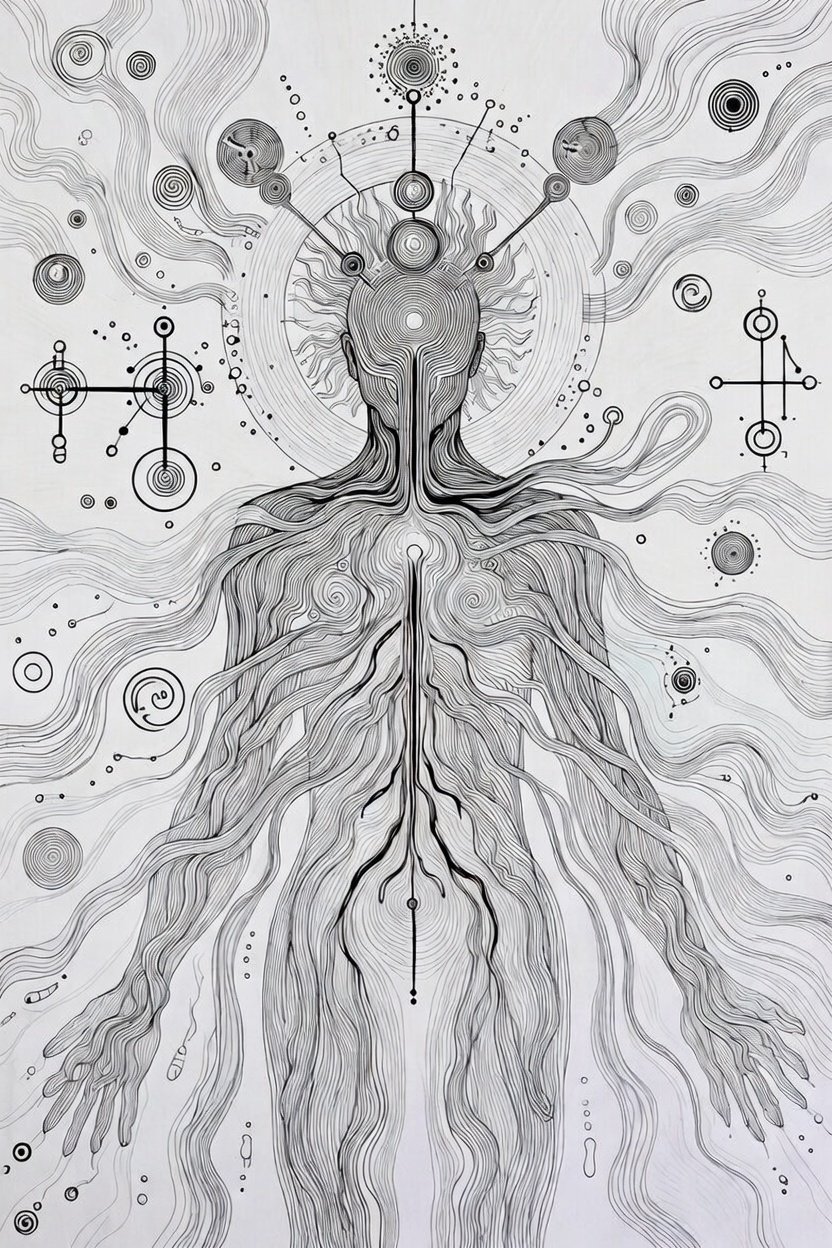
There is a recurring fantasy that runs beneath both modern science and modern spirituality: the idea that, underneath the world of solid objects, there is a single, continuous medium that links everything together. Call it ether, chi, prana, zero‑point energy, or the universal fluid; the names change, but the longing is the same. We want reality to be secretly unified, and we want that unity to be usable.
“Tesla’s Medicine: The Universal Fluid” steps directly into that fantasy. It takes the already mythic figure of Nikola Tesla—half engineer, half wizard in the modern imagination—and places him in a story where the boundary between physics and healing, electricity and consciousness, begins to dissolve. The result is less a straightforward biopic and more a meditation on what it would mean if someone like Tesla had truly discovered a field that intertwined technology, life, and mind.
Rather than asking, “Did Tesla really invent this?” the film invites a different question: “What does it say about us that we want him to have done so?”
This article approaches the movie on three levels:
- As a story about Tesla as an archetypal “tech‑magician.”
- As a speculative exploration of medicine based on fields and resonance instead of just chemistry and scalpels.
- As a symbolic myth about the human desire to find a universal medium that connects matter, mind, and meaning.
Tesla as Tech‑Magician, Not Just Inventor
In historical terms, Nikola Tesla was a brilliant and eccentric inventor, known for alternating current, high‑voltage experiments, and audacious proposals like wireless power transmission. But in popular culture he has become something more: the patron saint of misunderstood genius, the anti‑Edison, the wizard of lightning who was too visionary for his own era.
“Tesla’s Medicine: The Universal Fluid” leans heavily into that mythic image.
The film portrays Tesla not just as an engineer solving practical problems, but as someone haunted by the sense that electricity is more than a tool. It is portrayed as a language of nature—a way the universe speaks in patterns, pulses, and rhythms. Tesla is shown as hypersensitive to these patterns, both in the laboratory and in his own nervous system. His famous experiments with coils, sparks, and wireless transmission become, within the narrative, prototypes of a deeper ambition: to access the underlying medium that carries not only power, but also life and perhaps even consciousness.
This is a classic “magician” archetype in Jungian terms. The magician is the figure who mediates between visible and invisible worlds, not by faith alone, but by technique—by knowing the right words, symbols, or in this case, circuits. He does not merely believe in hidden forces; he learns how to arrange the outer world so that those forces reveal themselves.
The film’s Tesla inhabits that role. His laboratory is depicted as more than a workshop; it is a liminal space where invisible currents are coaxed into visible expression. He is not merely “innovating”; he is divining.
This framing is crucial, because it allows the film to explore an idea that would seem absurd in a purely historical drama: that Tesla’s work might lead not just to new technologies, but to a new medicine.
The Universal Fluid: Between Physics and Metaphysics
At the center of the film is the notion of the “universal fluid.” The script wisely avoids reducing this to a simple definition. Instead, it allows different characters to relate to the idea in different ways.
For Tesla, the universal fluid is first an extension of the ether of 19th‑century physics: a subtle medium that fills space and carries electromagnetic waves. As the story develops, his view becomes more metaphysical. He begins to suspect that this medium is not inert, but somehow “alive”—responsive, structured, perhaps even intelligent in a way that defies the mechanical metaphors of his age.
For the contemporary researcher character (often named Elena in variants of this kind of story), the universal fluid looks like a speculative cousin of modern bioelectromagnetics. She sees it as a way to talk about the subtle organization of living systems—the invisible patterns that guide healing, perception, and even mood—without collapsing everything into chemistry alone.
For corporate and governmental interests in the narrative, the universal fluid is a platform. If such a medium can be manipulated, it suggests the possibility of influencing biological and psychological states at a distance: an infrastructure for both miracle cures and invisible control.
For more spiritually inclined characters, the universal fluid naturally resonates with long‑standing ideas of a vital force: prana, chi, the Stoic pneuma, the Hermetic quintessence. In their eyes, Tesla is not creating a new theory so much as giving an old intuition a new technological vocabulary.
The brilliance of the film’s approach is that it never nails down which of these is “right.” The universal fluid functions as a boundary concept, sitting at the edge between science and myth. It allows the story to explore how a single idea can invite wildly different fantasies—healing, control, spiritual awakening, profits—depending on who holds it.
From a Hermetic or esoteric perspective, this ambiguity fits perfectly. In texts like the Corpus Hermeticum, the world is often described as animated by a subtle, intelligent medium: the World Soul (Anima Mundi). In alchemy, this gets expressed as the quintessence, the fifth element that penetrates and unites the four classical elements. In Kabbalistic terms, one might think of the subtle light that flows through the Tree of Life, animating the material universe.
The film’s universal fluid is a modern descendant of these ideas, translated into the language of electricity and fields. It is not trying to prove that such a thing exists; it is dramatizing what it would mean if it did, in an age ruled by machines.
Medicine as Resonance Instead of Intervention
One of the movie’s most intriguing threads is its reimagining of medicine.
Conventional biomedicine, as represented by skeptical doctors and regulators in the story, treats the body primarily as a biochemical machine. Disease is framed as a malfunction in parts or processes—an infection here, a tumor there, a neurotransmitter imbalance elsewhere. Treatment follows the same logic: drugs, surgery, and procedures are external interventions imposed on a mostly passive body.
In contrast, Tesla’s speculative medicine, based on the universal fluid, operates by resonance. The body is not just a machine; it is a dynamic pattern in a field. Health is the state in which this pattern is coherent, balanced, and self‑organizing. Illness arises when the pattern becomes fragmented, out of tune with itself or with its environment.
In this view, healing is not primarily about “fixing” parts, but about restoring coherent patterns. The universal fluid is the medium in which those patterns live. Tesla’s devices, as imagined in the film, do not overwrite the body’s intelligence; they amplify or nudge it, nudging disordered patterns toward renewed order.
A character in the film explains it with an accessible analogy: if the body is an orchestra, conventional medicine often acts like a mechanic—replacing broken instruments, dampening overly loud sections, or using force to keep everyone in time. Tesla’s universal‑fluid‑based approach aims to retune the instruments and restore harmony from within, using the underlying medium (the “air” in which the music moves, in the analogy) as the carrier.
Importantly, the movie does not present this as a simple utopia. It acknowledges:
- That such a medicine would face extreme skepticism, and rightly so.
- That early experiments could produce messy, inconsistent results: sudden improvements in some cases, strange side effects in others.
- That translating a subtle, field‑based view of life into marketable technology would be fraught with ethical dilemmas.
By embedding these tensions into the narrative, the film avoids becoming mere propaganda for “energy healing” or, conversely, a simple debunking. Instead, it invites the viewer to think: What if we really tried to build a medicine based on patterns and fields? What kinds of hope—and what kinds of danger—would that open?
Power, Control, and the Ethics of Invisible Influence
Every story about a new power is also a story about temptation. “Tesla’s Medicine: The Universal Fluid” understands this, and much of its drama arises from conflicts over how the universal‑fluid technology should be used.
When early tests of Tesla‑inspired devices suggest the possibility of modulating pain, mood, and even the intensity of certain memories, a cascade of ethical questions follows:
- If a device can reduce suffering by altering a person’s inner pattern, where is the line between healing and manipulation?
- If it can induce states of calm, euphoria, or spiritual insight, who decides when and how that is appropriate?
- If the same principle that eases depression could potentially suppress dissent, how do we safeguard against abuse?
In the film, corporate representatives see trillion‑dollar markets: chronic pain, mental health, stress management, enhancement. Government figures see a dual‑use technology: it might help veterans with trauma, but it might also become a tool for crowd control or interrogation.
The protagonist scientist—Tesla in his era, and a modern researcher in ours—finds herself pulled in all directions. She believes in the healing potential of the universal fluid model, yet she cannot ignore the prospect of coercive uses. She faces a classic esoteric dilemma:
When you discover a method of directly influencing subtle aspects of human experience, is it ever possible to ensure it will only be used benignly?
This is not a purely imaginary concern. In the real world, technologies like neuromarketing, algorithmic persuasion, and psychopharmacology already operate in this ethical gray zone. The film uses the more dramatic language of universal fields and Tesla coils to magnify a question we already face:
If we can reach into the patterns that shape perception and emotion, what do we owe to each other in how we use that power?
Esoteric and Psychological Readings
Seen from the standpoint of Western esotericism and depth psychology, “Tesla’s Medicine: The Universal Fluid” becomes more than speculative science drama. It becomes an allegory of psyche and world.
Here are a few interpretive threads:
The universal fluid as Anima Mundi
In Hermetic and Neoplatonic traditions, the cosmos is ensouled. There is a living medium—the World Soul—that links all beings. This medium is not just physical and not just mental; it is that strange middle realm where meaning, image, and subtle force intermingle. The film’s universal fluid plays a similar role: it is the “between” that connects matter and mind, body and environment.
Electricity as image of psychic energy
Carl Jung famously spoke of “libido” not just as sexual energy, but as a general psychic energy that moves through symbols, desires, and cultural creations. In the film, electricity and light serve as analogues of this invisible energy. Tesla becomes a figure who intuits how this energy moves, but struggles with how to live with it. His isolation, intensity, and occasional breakdowns echo the difficulties of anyone who becomes too identified with the role of “channel” for forces larger than themselves.
The scientist as magician
Historically, figures like Marsilio Ficino or Giordano Bruno combined cosmology, magic, and philosophy. The modern scientist inherits part of this role, but with a new set of constraints: experiments, peer review, patents, regulations. The film’s dual protagonists—Tesla then, Elena now—embody the tension between scientific rigor and visionary exploration. They pursue a holistic vision (a field connecting all things) while operating inside institutions that demand narrow, controllable results.
Illness and healing as patterns, not moral failures
An esoteric reading resists any simplistic idea that “dis‑ease” is a punishment or flaw. Instead, it sees symptoms as expressions of deeper patterns trying to reorganize. In this light, the universal‑fluid medicine is a metaphor for any practice—therapeutic, spiritual, creative—that helps those deeper patterns move toward a more coherent form. The risk, again, is that external intervention can short‑circuit a meaningful process if applied without respect.
From a Jungian perspective, the film is about how we relate to the unconscious—both personal and collective. The universal fluid is one more name for that immense, mostly unseen matrix of forces that shape our lives. To try to turn it into an instrument is a heroic, perilous undertaking.
Contemporary Resonances: Fields, Systems, and Wholeness
Although the story uses speculative devices and an explicitly fictional “universal fluid,” it taps into several real currents in contemporary thought:
- Systems biology emphasizes networks and patterns over isolated parts.
- Psychoneuroimmunology explores how mind, nervous system, and immune function interweave.
- Environmental science increasingly understands individual health as entangled with ecological and social systems.
- In physics, even without ether, fields remain fundamental; the world is not a bunch of disconnected pellets, but interactions spread in space and time.
None of this proves the existence of a literal Tesla‑style universal healing fluid. But it does make the film’s central intuition feel less alien: that health is a property of relationships and patterns, not just of individual organs or molecules.
The story also resonates with ongoing cultural debates:
- Between reductionism and holism in science and medicine.
- Between technophilia (faith that technology will save us) and technoskepticism (fear that it will control or dehumanize us).
- Between purely secular interpretations of reality and more symbolic or spiritual ones.
In that context, “Tesla’s Medicine: The Universal Fluid” serves as a kind of cultural thought experiment. It asks: what if we pushed our fascination with fields, resonance, and subtle energies all the way to the edge? What kinds of narratives would we tell about healing, power, and responsibility?
Reflective Questions for the Viewer
I’ll keep this non‑visual and focused on structured reflection rather than “picture this in your mind.” If you’d like to use the film as a mirror for your own thinking about science, spirit, and healing, you might work with questions like these in writing:
- About technology and power
- When you think of future technologies that can influence mood or consciousness, what feelings come up first: excitement, suspicion, hope, unease?
- Can you recall a time when a tool (digital, medical, or otherwise) significantly changed how you felt or thought? How did that sit with you, ethically and personally?
- About medicine and meaning
- Do you tend to see illness primarily as a mechanical problem to fix, or as part of a larger pattern in a person’s life?
- If you imagine a medicine that works partly by restoring patterns and relationships (within the body, between person and environment), what aspects of that feel intuitively right to you, and what aspects feel dubious?
- About the “universal fluid” as symbol
- Leaving aside literal belief, what does the idea of a universal connecting medium evoke for you? Comfort, claustrophobia, wonder, skepticism?
- In your own life, what has functioned as a “universal fluid”—something that seems to link disparate areas together? (For example: language, money, the internet, shared stories, laws.)
- About the role of the “magician”
- Who plays the role of magician in your world: scientists, therapists, spiritual teachers, coders, artists?
- How do you feel about people who claim to mediate between visible and invisible forces, whether those are psychological, spiritual, or technological? Where do you draw your lines of trust?
These are not questions with correct answers. They are ways of mapping your own position in relation to the themes the film explores.
Conclusion: A Myth for the Next Science
“Tesla’s Medicine: The Universal Fluid” is not a documentary about Nikola Tesla, nor is it a technical manual for real‑world therapies. It is a myth in cinematic form: a story that condenses many of our cultural longings and anxieties into a single symbol, the universal fluid, and a single emblematic figure, Tesla.
At the surface level, it gives us a gripping narrative about discovery, ambition, and ethical risk. At a deeper level, it stages an encounter between two ways of knowing:
- The mechanistic view, in which the world is made of discrete parts obeying fixed laws, and
- The field‑based, relational view, in which what matters most is not the parts themselves, but the patterns of connection that bind them.
By placing medicine at the crossroads of these views, the film reminds us that how we imagine healing reveals how we imagine ourselves. Are we machines to be fixed, souls to be saved, patterns to be harmonized, or all of the above at once?
Tesla, as portrayed here, becomes the archetypal threshold figure: an engineer who sees beyond his age’s metaphor of the world as an assembly line, but who cannot fully articulate a new paradigm. The modern characters who inherit his ideas struggle with the same problem. They stand between worlds: one foot in the lab, one in the realm of myth.
Whether or not any “universal fluid” exists as a literal substance, the idea itself is telling. It expresses a desire for wholeness in a culture that often feels fragmented—scientifically, politically, spiritually. The danger is that in our hunger for unity, we might grasp at any theory that promises to connect everything, no matter how uncritically. The opportunity is that this same hunger can drive us to think more carefully about relationships, systems, and responsibilities.
In that sense, “Tesla’s Medicine: The Universal Fluid” is less a prophecy than a question. It asks:
- What would it mean to take seriously the idea that we live in a world of interconnected fields, not isolated units?
- How would that change our approach to illness, to technology, to each other?
- And if we ever found ourselves with tools as powerful as those imagined in the film, would we be ready—ethically, psychologically, spiritually—to use them well?
Those questions reach far beyond the screen. They belong to anyone who has ever wondered whether the deepest medicine is not just what we do to the body, but how we understand our place in the invisible web that holds us all.